Vision Types
A lightweight storytelling format that helped teams explore product strategy across a fragmented organisation.
OVERVIEW
A lightweight storytelling format that helped teams explore product strategy across a fragmented organisation.
Thesis
At Compare Club, the hardest part of product strategy wasn’t generating ideas — it was making them visible across organisational silos.
To bridge that gap, I introduced Vision Types: short narrative prototypes that show how a future experience might work from the customer’s perspective.
By focusing on the first and last moments of an interaction, Vision Types made it easier for teams to imagine outcomes without getting stuck in implementation details.
What started as a simple storytelling device gradually became a practical tool for exploring product strategy across a complex organisation.
Context
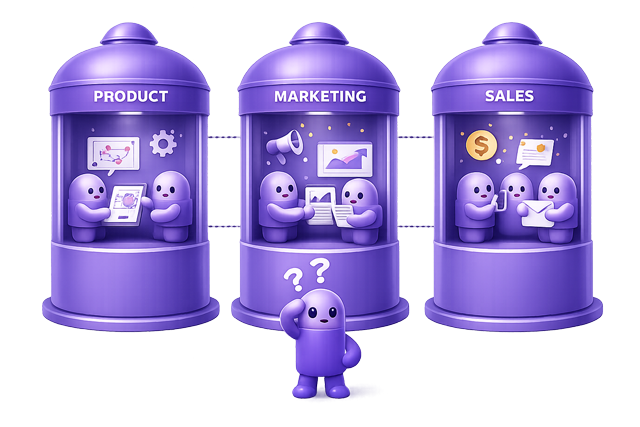
Compare Club operates across several verticals including health insurance, utilities, and financial services. Over time, each part of the business developed its own products, processes, and sales channels.
This created strong internal silos. Teams owned specific parts of the funnel, and information was often guarded within those boundaries.
The digital experience mirrored this structure. Rather than presenting a unified journey, the website was effectively organised around internal business units.
As a result, product discussions often focused on isolated features or campaigns, rather than how the overall experience should work for customers.
In this environment, imagining an integrated product vision was surprisingly difficult.
Diagnosis: Experiencing the Product as a Customer
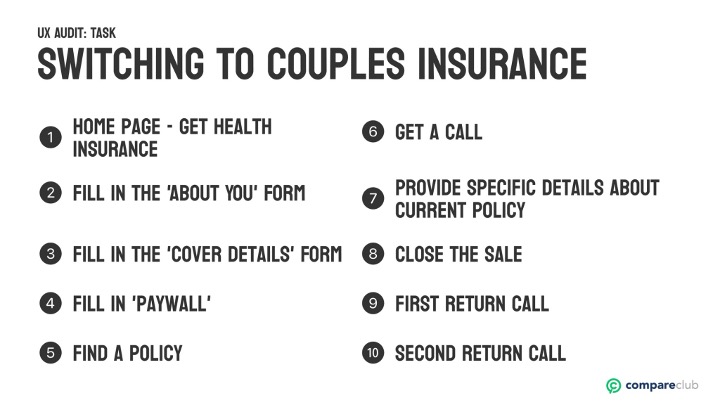
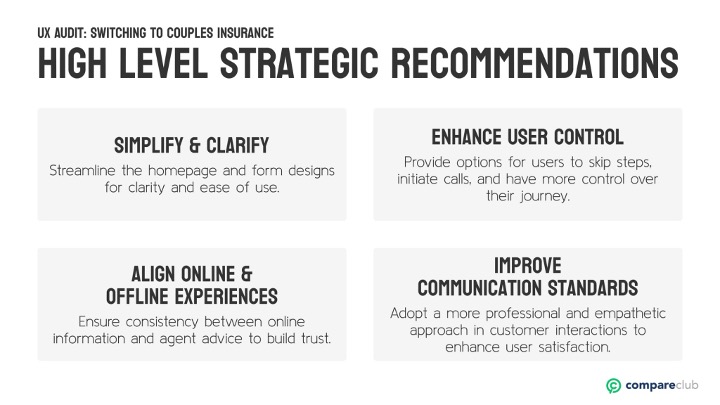
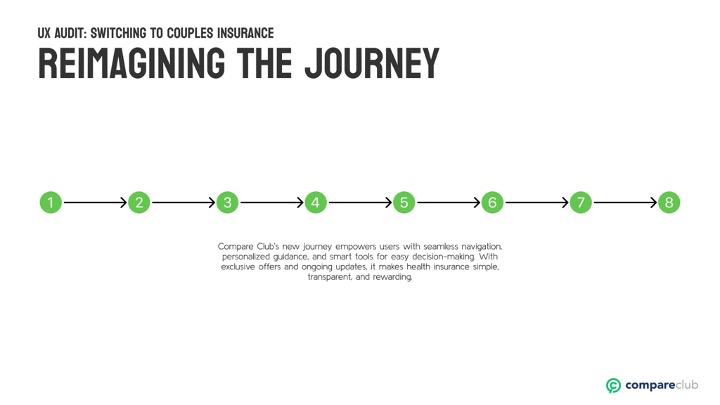
To better understand the experience, I conducted a heuristic evaluation of the core journeys and went through the process myself as a customer.
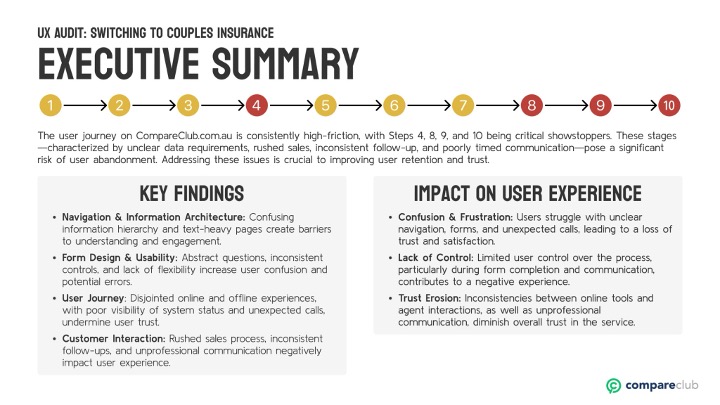
The audit quickly revealed that many of the issues were not isolated interface problems but symptoms of deeper structural fragmentation. Digital interactions frequently handed off to call centre processes, forms were difficult to navigate, and customers had little sense of control over what would happen next.
One recurring pattern stood out: trust and control were consistently compromised. Customers were often asked to provide information without clear context, while follow-up interactions with advisors sometimes repeated the same steps or introduced new uncertainties.
These experiences reflected the internal structure of the organisation. Each team optimised its own stage of the funnel, but no single perspective owned the experience end-to-end.
The result was a system that worked operationally, but was difficult for customers to understand or trust.
The First Vision Type
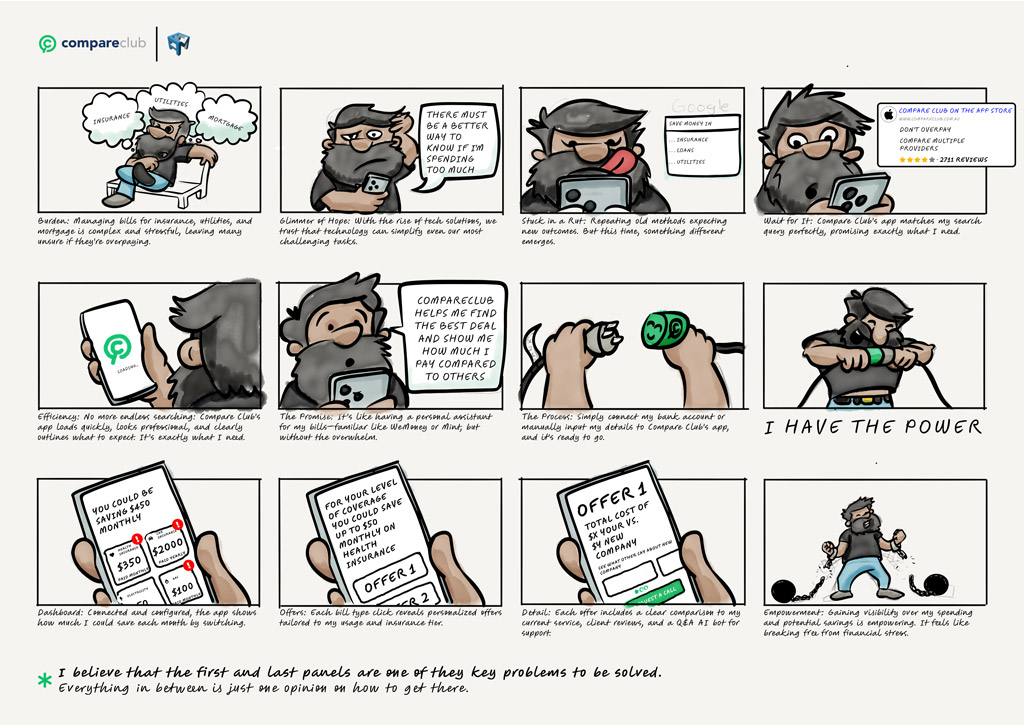
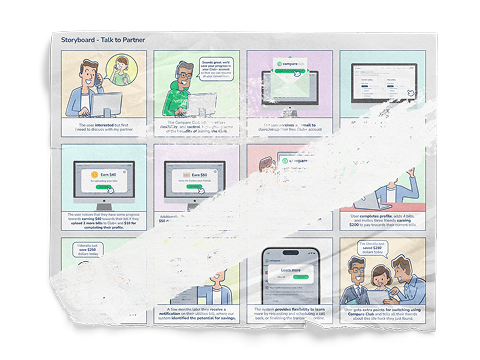
During the interview process for the role, I created a short narrative prototype to illustrate how a more integrated Compare Club experience could work.
Rather than presenting a roadmap or a list of features, the artifact took the form of a 12-panel visual story following a customer trying to understand and manage their household bills.
The format was loosely inspired by Marty Cagan’s writing on Vision Types — different ways product organisations articulate the future of a product or service. Instead of describing a strategy in abstract terms, I used a short narrative to show what that future experience might actually look like.
The goal was not to prescribe a specific solution, but to make the destination tangible: a future where Compare Club could help customers monitor, understand, and improve their financial decisions over time.
Each Vision Type focused on the first and last moments of an experience — the problem a customer faces and the outcome they want to achieve. Everything in between was intentionally treated as one possible path rather than a fixed specification.
This simple narrative format made it easier to discuss product ideas at the level of experience and outcomes, rather than jumping immediately into implementation details.
From Artifact to Tool
After I joined the company, the first Vision Type continued to circulate in conversations with my manager as we discussed potential directions for the product.
At one point he asked if I could create another one — this time exploring a specific feature request. The format turned out to be surprisingly effective for unpacking complex ideas.
Instead of debating features in isolation, we could quickly sketch what the full interaction might look like, from the customer’s perspective to the operational realities behind it.
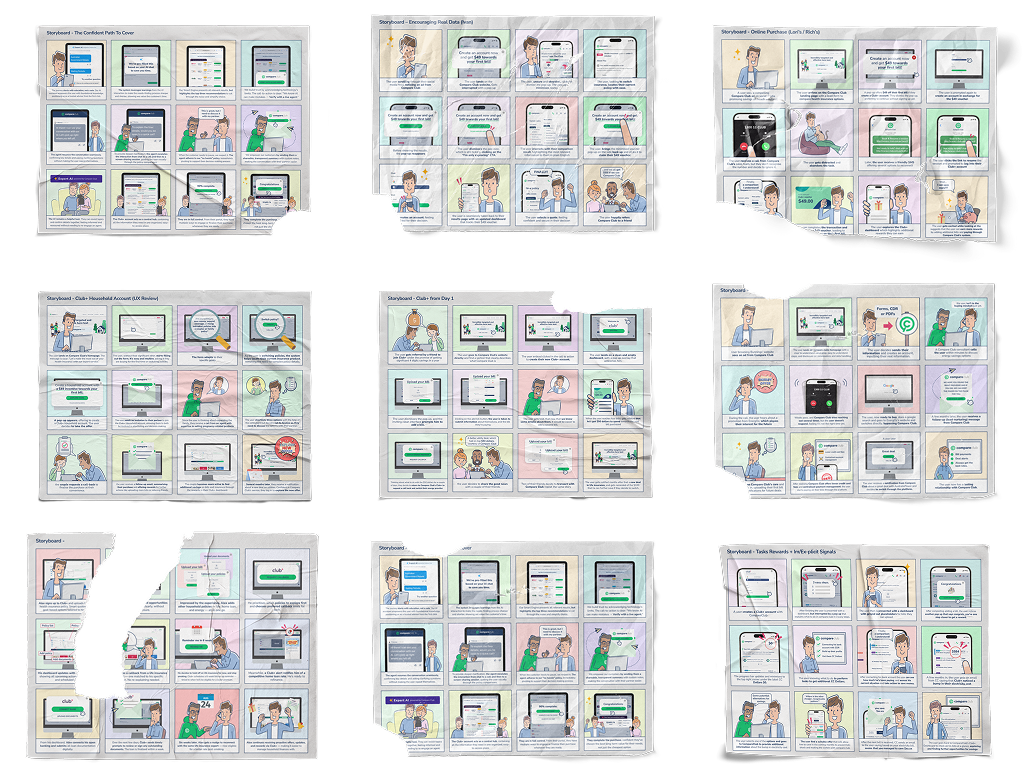
Over time, this led to the creation of nine additional Vision Types, each exploring a different scenario across the business: new product features, operational workflows, integrations, and customer journeys.
What began as a simple storytelling device gradually became a lightweight tool for exploring product strategy, allowing us to quickly visualise ideas and discuss them across organisational boundaries.
Why the Format Worked
In a complex organisation, many product discussions fail because ideas are described abstractly or framed too early as specific features. Vision Types helped bypass that problem by grounding conversations in concrete experiences.
By showing an interaction from beginning to end, the format made it easier for people to understand the outcome before debating how it should be implemented.
The artifacts were also intentionally lightweight. They could be created quickly, shared easily, and discussed without requiring extensive documentation or technical detail.
Most importantly, they shifted conversations away from individual features or internal ownership, and toward the experience the customer would ultimately have.
In an environment where organisational silos made end-to-end thinking difficult, Vision Types provided a simple way to make product vision visible and discussable across teams.
Example: Reframing a Payment Integration
One of the Vision Types explored a proposal to integrate Compare Club with a payments company owned by the same investment group.
The original request focused on the technical integration itself: enabling customers to manage or process payments through the platform.
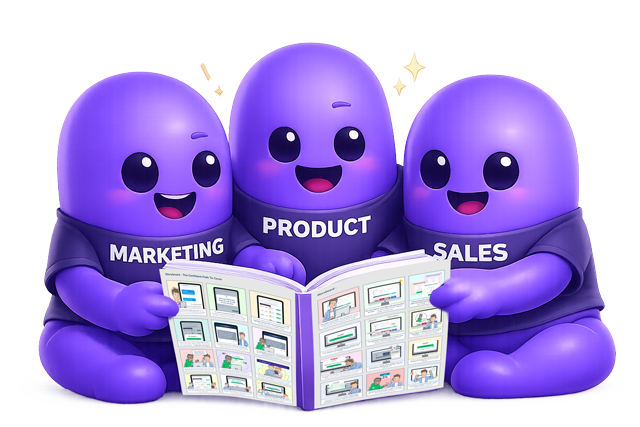
Using the Vision Type format, I reframed the problem from the customer’s perspective instead. Rather than centring the experience around payments, the narrative explored how customers might gain visibility over their household spending, helping them understand whether they were paying too much for services like insurance or utilities.
In this version of the story, payment data became a means to create financial clarity, rather than the product itself.
This shift helped move the conversation away from the mechanics of integration and toward the broader value proposition: helping customers monitor, understand, and improve their financial decisions over time.
Although the specific integration was ultimately not pursued, the thinking behind it later informed the development of the Club+ monitoring concept.
Cultural Adoption
As Vision Types began circulating within the product team, they unexpectedly took on a life of their own.
Colleagues started creating their own versions to illustrate product ideas, feature concepts, and operational scenarios. The quality varied — many were rough or simplified interpretations of the format — but the important signal was that the approach had become part of how the team explored ideas.
In a highly siloed environment, the narrative structure helped people quickly communicate how an interaction might work across different parts of the organisation.
What started as a personal tool for explaining product thinking gradually evolved into a shared language for discussing future experiences.
The format was never formalised as a process, but it proved useful precisely because it was lightweight: anyone could sketch an idea, share it, and invite discussion about the outcome.

Reflection
Vision Types reinforced an idea that often gets overlooked in product work: the hardest part of strategy is not generating ideas, but making them understandable across an organisation.
In complex environments, teams rarely struggle to propose features. The real challenge is helping people see how those pieces might come together to create a meaningful experience for customers.
By focusing on the problem and the outcome, Vision Types created a simple way to explore possibilities without becoming trapped in early debates about implementation.
In that sense, the value of the artifacts was less about the drawings themselves and more about the conversations they enabled.
Edgar held the role of Head of Customer Experience at Compare Club between 2024 in Sydney, NSW.